Thursday, 31 July 2008

And so it begins...


**Ring Ring **Ring Ring **Ring Ring **Ring Ring

- Hello, Occupational Health - Margaret speaking
- Good afternoon Margaret, my name is Michael, I’m one of the doctors due to start work at your hospital next week.
- Hello Michael, how can I help you?
- I received a letter from you asking me to call you. Something about missing information
- O.K., let me check my records can I have your full name and date of birth please?

I hear the tap-tap-tap of fingers on a computer keyboard and I try to visualise what Margaret looks like. In my head, I see a shortish woman in her late fifties with short, curly brown hair that is flecked with grey and a pair of large rimmed glasses that hang around her neck on a piece of string.

- Right, I’ve found you Dr Michael Anderson.
- That’s me
- Yes, I see what the problem is. We need some evidence that you are immune to T.B.

At one point I had a letter from an occupational health nurse confirming my TB immunity, but to be honest I have no idea where that letter is anymore. Probably among the many treeloads of paper that I’ve accumulated from “Induction Days” at previous hospitals

- I don’t think I’ve actually got any documents that say that
- I’m sorry doctor, but I can’t issue you with a “Fit to Practice” certificate unless I have some evidence that you are immune and you won’t be able to work without one.

My heart sinks a little at the thought of having to rifle through all the crap that’s currently in the “I Need To Sort All This Stuff Out At Some Point” box(es) under my bed. But then a thought hits me.

- I have a B.C.G. scar, I pipe up. - Is that evidence enough?
- Yes, that would be good enough, but obviously neither I nor any of my staff have seen your scar. Do you think you’d be able to pop in and show us?
- I live in NewCity! I can’t “pop in” because it’s about a two-hour round trip to your hospital. I do actually have an afternoon off this week but I don’t particularly want to spend it coming to show you my arm. Can’t I just come to the department to show you on Induction Day?
- Well, I suppose you could, depending on how many people we have to see that day, there may be a delay in issuing you with your certificate. You might have to wait a day or so.

I’ve already spoken to the anaesthetics office and it doesn’t look like I’ll be doing much actual clinical work in the first couple of days of the new job, so waiting a couple of days for occupational health clearance is unlikely to be a huge problem.

- O.K., well that’s fine with me. I’ll come in on induction day, and hopefully we can get it sorted then.
- Well, we shall see you then Dr Anderson
- Thank you. Bye for now
- Goodbye

**Click.

I hate Induction Day and it seems this time round, it’s starting even earlier than normal.

Wednesday, 30 July 2008

Another one leaves the flock


So, Dr Holly Branson has quit working as a junior doctor to work for her Dad instead.

I can’t say I blame her. In fact, I’m actually surprised that she’s remained in medicine for as long as she has. Why on earth would anyone want to work as a junior hospital doctor (for £21k p.a.) when their father is one of the richest men in the world? It seems that Holly has seen sense and has got out.

I wish her all the best (though I very much doubt she’ll need my good wishes).

Winding down...

After having a fantastic couple of weeks off, I’m back at work again. I think I’d gotten to the point where I needed a holiday. Getting out of bed had started to become even more of a chore than normal and I really wasn’t “throwing myself into it” as much as I normally did. Now I feel much more invigorated and am back to being super-keen again.

We junior doctors change jobs on the 6th of August. We move on to new positions, often in new hospitals and this is also the day that the brand new FY1 doctors start their first jobs. Lots of my fellow junior doctors appear to be on a “wind-down,” people are talking about where their next jobs are and what they’ll be doing there. Personally, I’m going to another District General Hospital and I hope to do quite a lot of work on the delivery suite.

Lots of the consultant anaesthetists and consultant surgeons are away on holiday at the moment, so there’s not as much work to do as normal and this adds to the “rest and relaxation” mood among the medical staff. It’s actually quite nice.

Some of the house officers are arranging a hospital ball on Friday, and I’m really looking forward to it. It’ll be a chance to get dressed up, a chance to share a drink or three with my colleagues, and also an opportunity to say goodbye.

Wednesday, 16 July 2008

Summer Holiday

Woohoo!

No more workin' for a week or two....

Thursday, 10 July 2008

Life-long learning 2


As I’ve said before, doctors should be committed to learning for the rest of our lives and the people we actually learn most from are the patients we look after.

Here are five things that I learned from my patients today:

1. Sea levels have been rising for the last 10000 years and are not rising any faster now than they were thousands of years ago, despite what the media say.

2. The needle didn’t hurt as much as she thought it would.

3. Christiano Ronaldo is a much better player than George Best ever was.

4. I look much younger than I am.

5. Just 2mg of midazolam can make a young man stop breathing completely.

Tuesday, 8 July 2008

Be careful what you wish for...

If you believe what’s said in the media, you’d probably conclude that our NHS is on its knees and on the verge of a meltdown. You’d think that primary care (GPs and A&E) is a complete disaster in this country and that it’s only a matter of time before the whole house of cards comes crashing down round our ears.

Despite this "obvious truth," it seems that people in other countries see what we have here in the UK as a good thing and are actually quite envious of our health service.

Funny that…

Free access to GP services is what I believe needs to happen. Then, and only then, will those on low incomes be able to take control of their health. Sure, it'll cost a hell of a lot of money. But if people could afford to go to their GP to get their cholesterol checked, to have their blood pressure measured, to talk about giving up the fags, then we could potentially claw back a significant amount of the money, while at the same time improving the nation's health.

But when you have the choice between paying 60 euro to have your BMI measured, or buy the tin of baby formula that your nipper needs, I know which most people would choose.


The full article is over here.

Friday, 4 July 2008

Am I a hypocrite?


I used to go running quite regularly, it was something that I really enjoyed doing. But, between studying and working and having a girlfriend, I hadn’t been for ages.


I went for a run last night and it was great. The sun was shining, but it wasn’t too hot and there was a slight breeze to cool me down as I ran. This country looks beautifully green at the moment and the people I passed seemed happy as they enjoyed the summer evening.

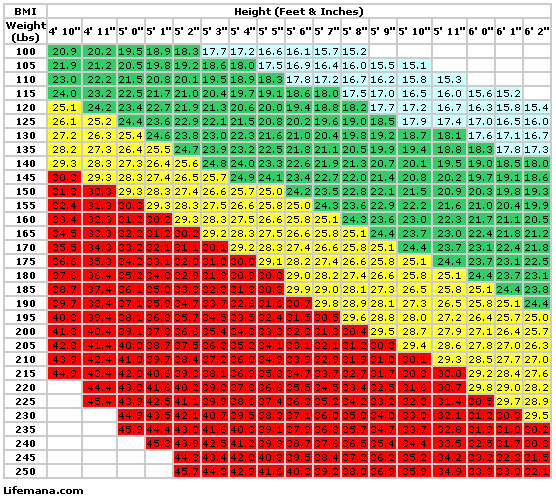
If I’m being honest with you though, I’d say that the real reason I went running was because I stepped on a set of scales the other day and discovered that I’m almost a stone and a half (9.5kg) heavier now than I was this time last year. On the BMI charts, I’ve slipped across the line from the Healthy Green to the Overweight Yellow. More tellingly, trousers that I bought because they were baggy are now looking distinctly “fitted.”

I’m not overly concerned though, nobody who knows me would describe me as “fat” and I’m sure the extra pounds will come off again, but it got me thinking about things I’ve said to patients about losing weight.

On many occasions, I’ve advised people that they need to lose some weight, that their size is damaging their health and on many occasions I’ve been exasperated when they “refuse” to do so.

“How hard can it be?” I’d whinge to my colleagues. “All they have to do is eat less and do a bit of exercise and then they would be in the hospital in the first place?”

But now, I’m officially overweight myself. So, do I have any right to tell another overweight person to lose some weight?

The question I’m asking is “Am I a hypocrite?”

And the honest answer has to be, “Yes, I am.”

I’m far from being alone in this though. In fact, I believe that the vast majority of doctors across the world have given advice to their patients that they, themselves flagrantly ignore.

I used to work with a consultant vascular surgeon who, every week for the majority of his working life would amputate people’s legs because their smoking had clogged their arteries, causing their leg(s) to rot. And every week, at the end of his list, he’d take himself off to the smoking room to have a few fags before reviewing the post-op patients.

Drunk people are so annoying in the A&E department. Not only because they can be loud, rude and aggressive, but because the effects of alcohol itself mimics the symptoms of severe disease (dizziness, drowsiness, slurred speech, vomiting etc…) and makes it much harder to exclude potentially serious problems. I used to bemoan having to clerk in drunk people on a Saturday Night but I knew that, had I not had to work, I would probably have been in the same bar, dancing like a tool and being almost as pissed as they are.

I know doctors that regularly take recreational drugs, even though they of all people know the harm these substances can cause.

What I’m saying is that there is a large amount of hypocrisy running through medicine and a large amount of the “Do as I say, not as I do” attitude that comes with it.

However, on the flip side of this, being a doctor certainly gives a different perspective of life and health. We’ve all seen people die in front of us in horrible, but avoidable ways and, as a result, we are morally and duty bound to try and help the person in front of us from doing the same.

I suppose what it comes down to is this. We are no angels, we never said that we were. I guess that our hypocrisy stems from wanting our patients to have as good a life as possible and from trying to get them to avoid the suffering that lies further down the path that they’re on.

We’ll continue to do this, even if we can’t take that advice ourselves.

Wednesday, 2 July 2008

Married to the job

Six Months ago...

I’m in the changing rooms, getting into my scrubs at the start of the day and I’m chatting with Jeremy, one of the other novice anaesthetists.

“I’ve started seeing someone,” I say

“Oh yeah?” Jeremy raises his eyebrow at me, “Who is she? Tell me more.”

“I’ve actually known her for a little while now, but things are just starting to get more serious. She’s fantastic though, and you know me, I don’t say that lightly.”

“What’s her name? Is she another medic?”

This is what you find in medicine. There’s the tacit implication that doctors only go out with other doctors and it’s almost as if you’re breaking the rules if you go out with someone totally non-medical.

“No, she’s not. She works in fashion, she’s called FashionGirl.”

“Oh that’s cool, so how did you meet?”

The conversation goes on along this vein for a few more minutes and then Jeremy leans into towards me and asks.

“Does she understand?”

“What do you mean?” I query.

“You’re planning to sit your primary exam this year aren’t you? Does she understand about the time you’ll need to study as well as spending so much time in this place?”

“Yeah, I’ve explained that to her.” I avoid his gaze as I say this because even in my own head, I’m not sure that FashionGirl really understands what lies in the few months ahead. I’m not going to be there a lot of the time. In the run up to my exams, I’m going to be married to my text books and there are going to be times when I’ll be so tired after work that I won’t want to speak to anybody at all.

“I’m sure it’ll be OK,” I continue, hoping that what I say will turn out to be true.

------------------------------------------------------

Last Friday Night...

FashionGirl and I are sitting having dinner and sharing a bottle of wine. I’d really been looking forward to seeing her because it felt like I hadn’t seen her in ages.

“You know, Michael” she says as she takes a sip and fixes me with her blue eyes, “I was really pissed off with you the other weekend.”

“When I said that I wasn’t going to come to Emma’s birthday do?”

“Yes. It’s not that you didn’t come, it’s that you said you would and then changed your mind the day before.”

“I know, but I’d just done a week of long shifts and I just wanted a night in.”

“I know that babe, but…” her voice tails off.

“But?”

“I don’t think it’s very fair that’s all. It’s just that sometimes it seems like I’m the one making all the effort. I’m always the one that comes over to see you. I know that you’ve had your exams and everything, but I feel that I’ve been really supportive over that whole period.”

“You have!” I interject as I recall her sitting in bed with me, quizzing me about the Gas Laws. “Very much so.”

“But, it seems to me that now you’ve got this free time that you could be making an effort too.”

“FashionGirl,” I say. “Remember that was my first free Saturday in weeks and I’ve been over to see you loads in the last couple of weeks.”

“I suppose that’s true.”

“And besides, I don’t think I would have been a whole lot of fun that night and, had I gone out with you guys, I reckon I would have spent most of the evening asking you to come home with me. I was in bed by 8 that night!”

“Actually, I’ve been meaning to have this chat with you for a little while now.” I continue. “There will be times where I won’t be able to do things that I said I would. There will be times when I miss doing something with you because of my job and there’ll be time where I really just want to be left alone and just sit in a dark room for a while. But please remember that all of that is just because of the job I do. It doesn’t mean that I care about you less, because I care about you loads, you know that.

“I remember in my first year after graduating, after a real nightmare shift, I called up my Mum and Dad and ranted and raved about how I was spending all my time at the hospital and it seemed I never got to do anything else.

“They said to me, ‘Son, it’ll only be for the first couple of years you know. As you move up the ladder, you’ll have to do less work and you’ll have more free time in a couple of years’ time.’

“But that’s not true, FashionGirl. It’s really not true at all. The higher I get up the medical career ladder, the greater my responsibilities get and I’ll be doing more work and have more commitments - not less. And that means that going into the future, this problem is just going to get worse.

“What I mean to say is that I do really care about you, you know I do, but there will be times when I let you down. All I can say to you is, when the choice is in my hands, I promise I’ll put you first. It’s the best I can do.”

Tuesday, 1 July 2008

The Crash Team

When somebody dies on a hospital ward, a “crash call” gets put out by a member of the ward staff. This comes through to the pagers of the members of the “crash team” who have only a couple of minutes or so to get to the ward and attempt to literally bring the dead person back to life again.

There is a definite order in which the various members of the crash team arrive at a cardiac arrest.

First there are the nurses due to the fact that they are actually on the ward when the person died and are often the people who put the crash call out in the first place. There’s usually two or three nurses there performing Basic Life Support (CPR) before the crash team arrives.

The first member of the crash team to get there is the Medical SHO. The Medical SHO is usually younger, quicker and keener than the other members and will try her best to organise a working airway, IV access, a heart monitor and give some emergency drugs.

The Medical SHO is quickly followed by the Medical FY1, who is even younger and fitter that the SHO, and would have been there first apart from the fact that he doesn’t want to get there, get scared by the situation and freeze with everyone looking at him and asking “What shall we do now, doctor?”

It takes about a minute or so for Advanced Life Support to get properly underway, and this is the moment when the Medical Registrar pitches up. The Medical Registrar is the leader of the crash team and she’ll have seen literally hundreds of these in her time. She’s got the knack of arriving early enough to potentially make a difference to the patient but late enough to allow the initial panic to die down and for everyone to slot into their roles so she can take over the overall running of the crash call.

Last to turn up is the anaesthetist. It seems that the anaesthetist’s role at a cardiac arrest is to turn up, sneer, suggest to the Medical Registrar that we should all stop now and then saunter off again. I used to think that this was because anaesthetists were lazy, but now I know that the reason we turn up last is because most of the time, cardiac arrests happen on general medical wards and in most hospitals, the general medical wards are nowhere near the operating theatres, which is where the anaesthetists hang out. The other reason is that the medics are perfectly capable of running the arrest without us, so we don’t bother making the long sprint from theatres to the medical ward (up to half a mile in some hospitals) and settle for a slow jog instead.

Saturday, 28 June 2008

It's Saturday


Thursday, 26 June 2008

So long, farewell, auf wiedersehen, adieu


It's with great regret that I bid farewell to two of my favourite bloggers.

Surly Girl and Mousie, I'm going to miss you.

All the best,

- Michael


Wednesday, 25 June 2008

Making a difference


I had such an amazing day at work today. In my time working at NewTown Hospital, I hadn’t really done any maternity work so, I was pretty excited when I found my name on the maternity rota for today.

I pitch up at the delivery suite and have a chat with the overnight anaesthetic registrar, who filled me in on how the suite worked and what sort of things I would be expected to do. It all seemed pretty straight forward. A few minutes later on, the consultant of the day, Dr Shah, pitches up and we go and investigate what work we were going to have to do.

There were two ladies who needed elective caesarean sections (C-Sections) and the Obstetric consultant told us that there were a few ladies on the unit that would probably need emergency C-Sections as well.

As a rule, women like to be awake when they have their C-Section, so they can see their baby straight away. This means that we give them a spinal anaesthetic (basically an injection into their spine to numb the nerves there so they can’t feel anything from their chest down).

I’ll be the first to admit that I’m not really very slick with my spinals. The technique is “blind” which means that you can’t see where the needle is going. So, what you have to do is imagine the 3-Dimensional anatomy and relate that image in your head to where you think the tip of your needle is and where you think it needs to be. I’m getting better at them though, and was glad of the opportunity to do a couple more today.

The first lady was called Mandy and she was almost exactly the same age as me. Mandy was very relaxed about the whole thing and said she understood what was about to happen – obviously the prenatal counsellors had done a good job. Her partner, James, on the other hand, was obviously a huge bag of nerves.

Dr Shah did the spinal anaesthetic and, in the process, talked me through how she likes them to be done. Once we were happy that the anaesthetic was working, we gave the surgeons the nod, and they cracked on with doing the caesarean section. 15 minutes later, they had the baby out and the room echoed to the sound of a baby crying as Mandy and James’ baby boy took his first breath.

Welcome to the world, little one.

Dr Shah let me take care of the next lady pretty much all by myself. Mrs McAllum was due to give birth to her 4th child. We’d already seen her in her room to let her know what to expect, to give her information about the procedure and allow her the opportunity to ask any questions or raise any concerns that she had.

The nurse went off to fetch Mrs McAllum and I checked all the anaesthetic equipment in theatre, I drew up the inotropic drugs that I would need and checked that my emergency drugs were drawn up and were readily available.

After siting a cannula into her hand and attaching her to a bag of fluids, I went to scrub up. I got all my equipment ready and made sure Mrs McAllum was in a good position and then I started.

First some local anaesthetic into her back and then I tried to find her subarachnoid space with the spinal needle. I couldn’t. I didn’t feel like I was hitting any bone, so I kept advancing the needle until it was all the way to the hilt, but still I wasn’t in the right place. Spinal needles are 12cm (approx 5”) long and Mrs McAllum wasn’t a particularly fat, so I thought I must have missed. I tried again but with the same result. Eventually, Dr Shah got bored of me poking around in this woman’s back and she got scrubbed up and took over. It turns out that, amazingly, the standard needle was too short for Mrs McAllum, and once we changed to an even longer needle, we were able to find the correct place and give her the injection.

The consultant obstetrician struggled for a while with the operation, but got there in the end and soon enough, Mrs McAllum’s fourth child, a boy, was breathing quietly in his Daddy’s arms.

Welcome to the world, little one.

In the afternoon, we helped two more women give birth. Their babies both had “foetal distress” and they needed emergency caesareans to prevent the baby from possibly being brain damaged or even dying. For the first lady, we had enough time to get a spinal in and working, but we had to give a general anaesthetic to the second lady.

All in all, it was a fantastic day. I was able to help these women during childbirth and, in the process, felt I made a real difference. I saw four babies being born and there were four very happy couples. The birth suite seems to be a very happy and enjoyable place to work and I was grinning from ear to ear as I walked out of the hospital at the end of the day.

I love my job.

Monday, 23 June 2008

The European Working Time Directive


In just over a year, the European Working Time Directive (EWTD) comes into full force for junior doctors. The directive will state that it will be illegal for our employers to make us work more than 48 hours each week. As things stand today, we are meant to be working a maximum of 56 hours – at least, in theory.

The general consensus among the junior and senior doctors that I speak to is that the EWTD is a bad thing. It’s a bad thing because it reduces the amount of experience that doctors in training have, it reduces how often we are exposed to and have to deal with a given situation. In the long run, it will lead to consultants being less qualified and less capable than they used to be, and thins will have a damaging effect on patient care.

The other, more pressing reason why the EWTD is a bad thing is because there will be a lack of continuity of care for the patients. In the old days, a patient coming into hospital would be seen by two or three doctors during their hospital stay. The EWTD means that the same patient could be seen by six, seven or more doctors. The said doctors won’t necessarily know all the details about the patient or what their colleagues have said or done, so as a result, things get duplicated or omitted and patient care suffers.

There has been plenty written about the problems implementing the EWTD and there have been calls from many individuals and organisations (including the excellent Remedy UK) for doctors to be made exempt from the EWTD, that is, that we should be working more than 48 hours a week.

I disagree with this.

I take the minority view that the EWTD is actually a good thing and will improve things for doctors and, more importantly, for our patients. Let me try and explain.

First of all, let’s not lose sight of what we are talking about here. At the moment, we are meant to work no more than 56 hours per week, the EWTD makes it illegal for junior doctors to work more than 48 hours every week. Given that the standard working pattern in this country is 9am to 5pm, then we are talking about a reduction from working 7 days a week to working 6 days a week.

Working 6 days a week is plenty of time. Working 6 days a week for nine years (for hospital specialties) is a long enough apprenticeship. (Remember, that all this comes after spending five years at medical school). After working 6 days a week for nine years, I think that doctors would be confident that they could deal with just about anything that their specialty could throw at them.

Working 6 days a week is plenty, PROVIDED THAT YOU ARE BEING TRAINED.

This is the real problem that medical training faces, if you ask me. As a junior doctor working in General Medicine or General Surgery, I spent so little of my time learning useful stuff, it was untrue. The vast majority of my time was taken up with form-filling, chasing results, phlebotomy, re-writing drug charts, cannulation and arranging discharges from hospital. As a proportion of the average working day, the time I spent learning about and trying to understand the management of the patients I was looking after was small. The time I actually spent managing the patients myself and taking decisions was minimal. The consultants were pretty unhelpful (sometimes spectacularly so) when I tried to find ways of improving my training.

The sad fact is that most of the time I was at work, I was learning little that was new. Cutting back on this time won’t make me a worse doctor, provided I still get experience of the important parts of clinical decision making and management.

The surgeons are talking about the cuts in their operating times and the consequent reduction in their experience. This may be true, but this has little to do with the EWTD and much more to do with NHS hospitals trying to save money.

It goes like this. The hospital gets paid by the Primary Care Trust (PCT) for each operation done at the hospital. A senior consultant can do an operation much faster than a junior registrar or SHO. So, in order to make more money, the hospital gets the senior consultants to do the vast majority of the operations. Good for the hospital, good for the patients, bad for the training of junior doctors.

I very rarely see the junior surgical doctors in theatres, but I remember as a medical student, the SHOs and SpRs had their own theatre lists of simple operations. This doesn’t happen anymore and I think the real reason why our surgeons aren’t getting the training they want is nothing to do with the EWTD and everything to do with the bottom line.

The message is simple: we juniors want to have proper training when we are at work. We want to be interpreting CT scans and making decisions based on them (under appropriate supervision, of course), we want to be diagnosing and treating medical emergencies, we don’t want to be filling endless reams of discharge forms and other paperwork.

The continuity of care issue is a tougher nut to crack, in my opinion. It is much better if all the doctors, nurses and paramedical staff know everything about each patient and understand what the plans for that individual are. However, this ideal is very difficult to achieve with the shift system that the EWTD necessitates. I don’t think that going back to the old “the same doctor will be here all the time” system is the way forward.

Let’s not forget the downsides to working very, very long hours.

I’m young enough to have avoided the days when junior doctors started work on Friday morning and didn’t leave until Monday evening, but I’m old enough to have done runs of 15hr and 24hr shifts and let me tell you, they are far from fun.

You can do one or two long shifts and still function quite well, but after five, six or seven on consecutive days, it can become a nightmare. You rarely get chance to eat properly on these shifts and you become ridiculously tired because you’ve hardly had any sleep. What happens is that you become really emotional, really bad-tempered and after a while you get to a point where your brain becomes like mashed potato. You can’t think straight and you find it difficult to summon the energy to even move.
But your pager doesn’t stop going. The patients don’t stop coming in and they all have to be seen and treated because they all need your help. So, I ask you, when you get called to see little Mrs Robertson, the 83 year old lady from a nursing home with multiple medical problems who’s come in because she’s “not eating much” and all your body wants to do is eat something and lie down for a bit; are you really going to pick up the super-added pneumonia that she has on top of her worsening heart failure? Are you? Really?

The worst thing about working really long hours is that you become really resentful. You become resentful of the hospital, resentful of your decision to become a doctor and, worse of all you become resentful towards the patients. You start to feel animosity towards the very people you’re supposed to be helping and that is a really horrible thought situation to be in. You feel awful about yourself for thinking those thoughts, but you can’t stop yourself because, ultimately, what is standing between you and the sleep that you crave are the ill patients you have to look after.

There are huge rafts of evidence that point to the fact that tired doctors make bad decisions and the care of patients suffers. I think the opponents of the EWTD should be very careful what they wish for. Like I say, working six days a week is enough.

I love my job as a junior anaesthetist. Since I left General Medicine, it’s been a breath of fresh air and I’m really enthusiastic and passionate about what I do and about caring for my patients. I think a huge part of the reason for this is the way that anaesthetic training is set up.

In the last ten months, I’ve given over 300 anaesthetics to patients. In that time I have had outstanding support from my seniors, but have been given enough space to get on and do things by myself. The paperwork I have to do is minimal and is to-the-point and useful and most importantly, people leave me alone to get on with my job. There’s no expectation that I should be in four places at the same time.

I’m working a 48-hr EWTD compliant(ish) rota and it means that I don’t go home feeling shattered and pissed-off with my job. I have the time and the inclination to do things outside the workplace and my life is much happier for it. I found myself looking up the route of the median nerve in my anatomy book after work last week, I would never have done that if I had to work more hours. I think all-in-all the training I’m getting in anaesthesia and the free-time that the EWTD allows is making me a better doctor, not a worse one.

I think the other medical specialties should look at the way training in anaesthesia is structured and take a leaf out of that book.

Working 6 days a week is enough.

Wednesday, 18 June 2008

Money, money, money


There’s loads in the news about the economy today and how the credit crunch and rising commodity prices mean that we’re all going to have less money for the foreseeable future. I’m quite annoyed by the fact that there are economists all over the telly telling everyone how “it would be really dangerous if public sector workers got pay rises.”

We junior docs got a 2.2% pay increase this year, despite the fact that inflation is at 3.3% and set to rise. I think it’s ridiculous to say that the city workers and bankers who caused the credit crunch can take home six-figure salaries and five-figure bonuses, but that doctors and nurses are not allowed a pay deal that keeps up with inflation.

The thing is being a junior doctor is an expensive business. I was working out exactly how expensive during a theatre session this afternoon and I came up with this list of fees that I have to pay this year in addition to the usual travel and clothing costs that every worker has to pay.

FRCA Primary MCQ Exam Fee: £260
General Medical Council Registration Fee: £390
Medical Indemnity Insurance: £60
Membership of the AAGBI: £55
FRCA Primary OSCE/Viva Exam Fee: £450
Anaesthetic Textbooks (to date): £175
Advances Trauma and Life Support Course Fee: £550

Total: £1940!

Looks like I won’t be going on holiday this year…

Monday, 16 June 2008

Things have come a long way


One of the patients on my list today was a young chap who had come in for a repair of his hernia. It was all pretty routine stuff, but what struck me about this guy is that he was seriously BUILT in that he was about 6’4” has huge muscles all over. I chatted to him for a bit in the anaesthetic room and it turns out that this guy is a boxer and was very disappointed to have to have surgery as he was hoping to turn pro at the end of the year.

I had a few reservations just because of his sheer bulk, but he actually turned out to be really easy to anaesthetise. He had huge veins and the fact that he doesn’t smoke or drink meant that I had very few problems with him on the table.

Once he was “under” I turned to the theatre nurse, Adam, and said, “Tell you what, I certainly wouldn’t fancy my chances in a fight against this guy, look at the size of him!”

To which Adam replied, “yeah, but remember that you’ve got the drugs, so you’ll always win!”

The drugs we use these days are pretty damn good in my opinion, but as Knowmore writes, this wasn’t always the case…


The kindly patient's left hand threw the Surgeon to the ground and his
right-hand the scrub nurse into the sink. He then determined to leave the
operating theatre by the simple process of running up the staircase with me
still attached round his neck, the mask clamped determindley to his face

Friday, 13 June 2008

Results Day


The Royal College of Anaesthetists (RCoA) said that they’d publish the exam results yesterday. I figured that it was unlikely that the results would be out first thing in the morning, so I waited until the end of the morning theatre list before looking. I nervously logged on to the computer and went on to their website only to be greeted with a message saying something like “we are still checking and verifying the results and we hope to publish them before 5 o’clock today.”

Great.

I continue doing my job and at 16:30, I wander round to the computer terminal in the operating theatre and log on again. It’s there. There’s a link that says Primary MCQ Pass List.

At this point, I’m physically shaking. My mind briefly flicks back to the weeks and weeks of work I put into sitting this exam. To the stag parties, house parties and sports matches I’ve missed because of my study schedule. I think once again of how fucking depressed I’ll be if all that has gone to waste. I’ve been speaking to the SHOs and registrars in the last week or so and none of them who have passed this exam answered anywhere near all the questions on the paper (negative marking) and I thought that perhaps my gung-ho attitude to the paper was a little foolish.

Anyway, all that’s behind me know and and shake my head, take a big breath and click the link.

A .pdf file opens and the hospital computer system slowly downloads its contents. I look around at my patient on the table, she’s fine, completely stable and well anaesthetised. I look back and the file had opened.

It’s a simple list of numbers with the word “PASS” in blue next to each number. I realise that it’s a list of our candidate and royal college numbers and there were several missing from the sequence e.g. numbers 100 and 102 were on the list but 101 was not. Basically if your number was on the list, then you had passed.

I quickly scroll down a couple of pages to where my number should be.

I look.

I look again.

I check my candidate number on the letter that the RCoA had sent me.

I look again.

It’s there!

I check the letter again.

I look again.

It’s definitely there!
Without a shadow of a doubt.

I’ve passed!!

“Come on!!” I shout. “That’s what I’m talking about!” This causes everyone in the room to stop and look round at me and I beam back at everyone.

“I just found out I passed my Anaesthetic Primary MCQ Exam.” I state and I get lots of “Well dones” and “Congratulations” in response.

This means that all the hard work I’ve put in was time spent well and, more importantly, I effectively get most of the summer free of study so I can really enjoy myself. And enjoy myself, I will.

I spent the rest of the day feeling generally pleased with myself and letting every single person I bumped into, doctors, nurses, patients and porters know what I’d achieved.

I was laughing all the way to the bar.

Wednesday, 11 June 2008

Hospital Trekking

One of the parts of my job as a junior doctor that doesn’t often get acknowledged is its physical aspect.
I was on call today and as part of my duties I visited main theatres, three surgical wards, the intensive care unit, the discharge lounge, two medical wards, day case theatres, the surgical assessment unit, the paediatric ward, the Department of Anaesthesia offices, the gynaecology ward and A&E resus.
Trust me, it’s a LOT of walking (and sometimes running) and after a 13hr shift, I frequently come home with my legs aching and my feet throbbing, just like they are now, in fact. I’d actually be interested in how far I walk on a typical on call shift, maybe I should get one of those pedometer thingies and find out.

Monday, 9 June 2008

The Exam


I’ve not written much over the last week or so because I’ve mainly been down the pub after sitting my first post-graduate anaesthetic exam last Wednesday. Now the hangovers have gone, I thought I’d write a little about how I feel about the whole process. I’ll warn you now that this post is probably not going to mean a fat lot to the non-medical readers, but it’s something that has taken a hell of a lot of my mental energy recently

On sitting it early.

Traditionally, the Royal College of Anaesthetists (RCoA), who set the exam, wouldn’t let doctors even attempt the paper until they had done a minimum of 18 months work as an anaesthetist in a recognised training job. The MMC shake up to post-graduate training has meant that they’ve relaxed the rules about this and now say that you can sit the exam once you have your “Certificate of Basic Anaesthetic Competencies” which takes about 3 months to get. They haven’t changed the examination itself, so by deciding to sit the exam early (after 10 months as opposed to 18) I was putting myself at a potential disadvantage.
Advice from the consultants and registrars who have passed the exam varied. Some strongly advised me to wait for another few months and sit it in September (13 months in), whilst some said that I may as well get on with it so it’s out of the way.
I decided to go for the early option because the exam is theory based, so passing it is more a matter of doing loads of book rather than practical experience. Also, should I fail, I can get another crack at it in September and still be on course so pass all parts of the exam by the end of 2008.
Whilst studying, it became apparent that experience IS important. For example, there’s lots of stuff about pregnancy, its physiological changes and about how regional and general anaesthesia is different in a pregnant woman. Now, I’ve done absolutely no obstetric anaesthesia, so I had to learn all the facts “dry” as I had no real experience to relate them to.

The run up

I worked really hard to study for this exam. I mean really hard. I was putting in 3 hours of study after a working day and up to ten hours on the weekends. The spectre of being stuck in New City for a whole year longer was more than enough motivation to keep me in my revision chair. In the last week before the exam I think I was starting to go a bit stir-crazy. I was having headaches all the time and found it really tough to concentrate. I think probably pushed myself a little too hard, but this exam is notorious for being the hardest post-grad exam of all the specialties so it was a case of “needs must.”

Negative Marking

The exam paper itself is a multiple choice paper that asks 450 True/False/Don’t Know questions. The paper is negatively marked, so you score 1 for a correct answer, 0 for a “don’t know” and -1 for an incorrect answer. The pass mark is about 55%.
This is the last time that the RCoA are using negative marking and good riddance is what I think. A pass mark of 55% on a negatively marked paper means that if you decide to answer all the questions, then you need to get just over 75% of what you’ve answered correct. If you decide to pass on some questions, the percentage of correct answers you need to give goes up too. So there’s a balance between answering enough questions to pass the paper and not guessing at questions and picking up negative marks.
Lots has been said about various approaches to negatively marked papers and how many questions is the “ideal” number to answer. To be honest, it was all too complicated for me, so I decided to keep it as simple as possible and answered just about every single question on the paper. This is a high-risk strategy because it means I’m more likely to fail if I haven’t done quite enough work, but it also means that I’m more likely to score very highly if I have - “Live by the sword, die by the sword.”
I based my study and revision timetable round doing as many practice MCQs as I possibly could. I borrowed books like QBase and the RCoA Blue Books and I went on websites like onexamination.com and frca.co.uk. In my opinion, some of these resources aren’t as helpful as they claim to be and were a bit of a waste of money. I was particularly disappointed with Onexamination.com in particular as it is out of date, and gives far too much weighting towards the random minutiae rather than the core knowledge that you need to pass.

Pre-exam chatter

I really don’t like chatting to other candidates before exams and before interviews. The conversations you have are utterly pointless and talking to other people only makes me feel worse about my prospects for passing. I arrived as close to the exam start time as I dared to and took myself away from everyone else to sit on the floor in the corner. It’s not that I’m anti-social, it’s just that I think there’s a time and a place for chit-chat and the lobby to the exam hall isn’t it.

The exam itself

I think the exam itself was tough, but then again, I was expecting it to be very tough. What I’d say about it is that I thought the exam was fair. The vast majority of the questions were based around core anaesthetic knowledge and the drugs that you’d reasonably expect an anaesthetist to know about. There was very little in the way of random, irrelevant trivia, so I can’t really complain about the exam questions themselves. As always with these things, there were bits that I knew right of the bat, bits I had no idea about and those annoying questions where you can remember reading the information but just can’t recall the actual answer. I was thanking my lucky stars that I flicked through the section about skeletal muscle in my histology book but was kicking myself that I neglected to learn how ketamine is metabolised.

Post-exam wind down

It feels fantastic to not have to study anymore. I can come home and just do normal things like watch TV, go for a run and cook dinner without the constant incantation of “I should be studying, I should be studying, I should be studying” going round and round my brain.
I honestly have no idea whether I’ve passed or failed, but I really do think that I’ve probably worked as hard as I possibly could have done. Fortunately, the RCoA don’t hang around too long with the marking and I will get my results on Thursday.

In the meantime, my life has quickly reassumed a familiar pattern – and it’s back to work again tomorrow.

Monday, 2 June 2008

Thank you

A big thank you to all who wished me luck for my exam tomorrow. It feels like I've been eating, sleeping and breathing anaesthetic facts and trivia for the past six weeks and I am sooooo looking forward to it being all over in less than 24 hours!

This time tomorrow, I'll be in the pub.

I can't wait.

Thursday, 29 May 2008

I’m feeling focused

At the start of the year, I made a promise to myself. I promised that I would spare myself the trauma of applying for jobs this year, and I would focus on passing the Fellow of the Royal College of Anaesthetists (FRCA) Primary Examination instead.

That was the talk, now it’s time for action. The first (MCQ) exam is next Tuesday, meaning I have only a few days left of study to go. I’ve not been blogging much recently because I’ve been working really hard over this past month or so – sometimes putting in nine or ten hours study per day. To be honest with you, this exam is rock hard and very soon, I’ll find out if I’ve done enough work.

Though my study period so far, I’ve been through self-delusion, pontification and despair, but in the last fortnight I’ve developed a sort of gritty focus that will hopefully see me through.

The exam is negatively marked and the FRCA website says that to pass you need to score about 53%. In the last week or so, I’ve been scoring 48-58% so, as things stand, my chances of passing are about 50-50. I’ve had lots of advice from the other SHOs and SpRs who have been through it and medical staffing have been very understanding. Now it’s all down to me and I’m determined to pass if only because I’ve invested far too much of my time and mental energy on this exam. Failure is not an option.

Right, now I’m off to learn which of the neuromuscular blocking drugs have active metabolites.

Wish me luck.

Tuesday, 20 May 2008

Stupid Me: Story #4514

I’m a fourth year medical student and it’s the summer. I wake up in my bed in the hospital accommodation and realise to my horror that I’ve slept through my alarm. I’m supposed to be in the paediatrics clinic at the other side of the hospital in exactly 18 minutes.

As a cohort, we’d already had the lecture from the lead consultant about “showing courtesy and respect” in the way we dress and the way we act around the children and parents, so I was sure she wouldn’t be impressed if I rucked up late to my very first clinic with her.

I leap out of bed, brush my teeth and get myself washed and dressed in about 10 minutes. I grab my stethoscope and white coat and run towards the Outpatients Department. When I need to, I can move at quite a rate of knots and I hurtle past the hospital canteen and charge into one of the swing doors that leads to my destination.

Only problem is, the swing door doesn’t swing. There’s something behind it; or, more accurately, there’s someone behind it. I look up to see the face of the consultant physician from my previous block squashed and framed perfectly in the window of the swing door.

“Ah, I’m so sorry!” I shout over my shoulder as I keep running and don’t look back…

Thursday, 15 May 2008

How the NHS works

Tuesday, 13 May 2008

It’s there if you want it…


It's well known that a minority of health professionals abuse drugs and alcohol. I'm happy to say that abuse of hard, medical narcotic drugs happens very rarely (as far as I know). One of the things that really surprised me when I started working in the operating theatres as an anaesthetist was the easy access to, and ready availability of narcotics to me.

In anaesthesia, we give just about all the street drugs (heroin, cocaine, barbituates, tranquilisers, ketamine) plus many others (morphine, fentanyl, midazolam etc… etc…) in their pure medical form to our patients to help them through surgery.

Strict restrictions exist over these “controlled drugs” but the restrictions only go as far as to the point when the drug leaves the drug cupboard. What happens to it after that is purely in the hands of the nurse or doctor who signed it out.

In my job, I’ve wandered round with syringes full of heroin, ketamine etc… in my hands and I’m telling you, it would be the simplest thing in the world to slip the odd syringe into my bag to “enjoy” later.

I suppose that if you are that way inclined, then you’d find a way of getting your hit, no matter what, but I think this shows the amount of trust and responsibility our employers, our patients and the public as a whole put on us health professionals to behave ourselves.

The occasional bad apple will abuse this trust but the majority of us would never dream of abusing medical substances. This is partly because it goes against everything we’re training for and also because, as doctors, we’ve seen too often where that road ends.

Friday, 9 May 2008

Can you answer this riddle?

If one doctor doctors another doctor does the doctor who doctors the doctor doctor the doctor the way the doctor he is doctoring doctors? Or does the doctor doctor the way the doctor who doctors doctors?

Thursday, 8 May 2008

You're Fired (or maybe not...)


I was watching The Apprentice the other week and the candidate’s task was to put on a themed dinner in a pub. As per normal, general chaos ensued. One of the teams was in the market, trying to buy tomatoes but they really didn’t know how many they needed and so had to try and wing it. Sir Alan Sugar was not impressed and he said something like:

“It seems to me that you had no bleeding idea how many tomatoes you were buying. You had no idea how much soup you were expecting to sell so you had no idea how much soup you needed to make and how many tomatoes you needed to buy. What did you do? Did you just pluck a figure out of the air did you? That doesn’t seem to be a very smart way to go about business if you ask me…”

The reason I bring this up is that it strikes a chord with the ongoing MMC fuck up. One of the biggest errors of MMC 2007 was around workforce planning. The Department of Health seem to have no idea how many consultants they will need, how many they want to employ and thus, how many junior doctors they want to train. How on earth can you plan medical school numbers and training positions for junior doctors without this most basic of information? I know that people aren’t tomatoes but the principle of basic planning surely applies. No wonder it’s all going tits up.

The House of Commons Health Care Committee has released its third MMC report and it seems that they agree with me that the people who ran MMC had “no bleeding idea” how many doctors they need in the NHS (see paragraph 19 on this link).

I’m sure Sir Alan Sugar would have had no truck with this level of staggering incompetence, but unlike The Apprentice, Liam Donaldson hasn’t been fired. He’s still sitting pretty in his job after screwing with the lives of literally thousands of junior doctors.

Wednesday, 7 May 2008

Finals Countdown

There are a lot of very worried looking final year medical students hanging round the hospital at the moment. They’re pretty easy to spot. It’s the bags under their eyes, it’s the gaunt expressions it’s their whole demeanour that just screams out “I am stressed.”

I don’t like thinking back to the time that I sat my finals because it was really horrible. I’d actually go as far as saying that the run-up to my final medical exams was the worst three month period of my life so far.

Five years of study gets compressed down and assessed in a two-week period. There’s nowhere to hide, you really have to stand up and be counted. The sheer volume of stuff that you have to know is immense. You know that the examiners could pick just about anything in the field of medical science to test you on, so you really have to be able to talk and write sensibly about everything.

You pray that you get something “easy” to get examined on - something like angina, multiple pregnancy or osteoporosis. But you know that they could just as easily pick rare conditions like facioscapulohumeral dystrophy that you may never ever have heard of.

Your whole academic year is trying to achieve the same goals at the same time and EVERYBODY is stressed out. A good proportion of my year were on some sort of anti-anxiety medication in those weeks before the exam. It ends up being like a pressure-cooker of stress because everyone you speak to about the exam is stressed out, and the fact that they’re stressed makes you more stressed, which then stresses them out more and it goes on and on like this.

People who have been through finals try to comfort you by saying stuff like “Just do the study and you’ll be fine. You have to remember that the vast majority of people sitting Finals pass them. The University WANT to pass you, so you have to fuck up pretty badly to fail.” I’m not really convinced that hearing stuff like that was particularly helpful though.

The worst thing about it though is that there seems to be no end to it. There’s nothing to look forward to, there’s nothing to enjoy. You wake up, you study, you go the hospital to try and see some patients. There’s loads of you all doing it so the doctors, nurses and patients in the hospital get pissed off because there are loads of students hanging around. So you come home and study some more. This pattern is repeated day after day, weak after week, month after month and it gets really, really depressing.

Anyway, my finals came and went. They were just as horrible as I imagined them to be. I was unlucky. I didn’t get the easy topics like heart disease or hernias, I got the random stuff and it was horrible. I got through it though. I’d done enough work to say something sensible in each viva so I passed. I got my medical degree and earned the letters after my name and the right to call myself “doctor.”

It took me several weeks to de-stress afterwards, to get my personality back and feel like my normal self. Medical finals are horrible and my heart goes out to all the medical students studying for them up and down the land.

I wish you all the best of luck.

Saturday, 3 May 2008

A quick tip


People of Britain, if you are going to start a fight whilst drunk tonight, try not to pick on anyone who is:

a) harder than you
b) more sober than you
c) both

If you fail to follow these simple rules, then there's a good chance I'll be seeing you tomorrow...

Thursday, 1 May 2008

Physician's Assistants

I’ve heard about Physician's Assistants (previously known as "Anaesthetic Practitioners"), but didn’t really know much about them. These are people who aren’t doctors, but have been on a 2-year diploma course to learn how to give general anaesthetics, and thus work as anaesthetists. There aren’t any such people in my hospital, but one of my friends from uni has worked with them before. I asked him how the Physician's Assistants fitted into the grand scheme of things and the conversation we had was illuminating to say the least.

It seems that someone had a bright idea…

“Gather round people, I have a brainwave. I’ve been spending some time in the operating theatres recently and I’ve seen what happens down there. It seems to me that these anaesthetists don’t do very much. They give a couple of injections, put a tube into the mouth and that’s about it. We have to pay them all this money and I reckon it’s money for old rope. I don’t think you need to be a doctor to give a general anaesthetic. I reckon that you could send people on a diploma course for a couple of years and after they finish, they’ll be qualified enough to give a general anaesthetic. As long as the patients are reasonably healthy, then these people could provide the anaesthetic and do away with a couple of expensive doctors.

“Of course, patient safety is paramount, so there must be a fully trained consultant anaesthetist immediately available should anything start to go wrong and we’ve worked out that one anaesthetic doctor can safely supervise two of these Physician's Assistants at the same time.

“So, here’s the proposition. We could set up the theatre lists so that these Physician's Assistants could have only healthy people on their lists. This means that we run two theatre lists simultaneously with two PAs and one expensive doctor! We get twice the work from a single doctor! It’s genius!”

So far, so good.

The trouble is, giving an anaesthetic isn’t really that simple. In order to give a safe anaesthetic, you need to know a lot of stuff. You can’t train just anyone to do it, especially in only two years. You need clever people.

The problem is, clever people are expensive. The powers that be quickly found out that, in order to attract people to the course who would be bright enough and motivated enough to actually finish it, they had to offer salaries of £35000+. (In fact, The Ferret pointed out this advert offering £42 - £49K for an Physician's Assistant job based on a 37.5hr week.)

Now, in my friend’s hospital, unlike the junior doctor anaesthetists, the Physician's Assistants don’t work evenings, nights or weekends, they only anaesthetise healthy (ASA I and II) patients, they do not anaesthetise anyone with moderate medical problems, they do not anaesthetise children, they do not do epidural, spinal or any other regional anaesthesia, they do not cover emergency surgery, they do not cover trauma theatres, they do not cover A&E, ITU, maternity or the delivery suite and they are not part of the crash team.

In short, they are not employed as “replacement junior doctors” (who would otherwise be working on the healthy patient lists), but they are being employed as “Consultant-Lites”

Let’s look at the simple maths of the comparative salaries for two surgical lists run by the two systems

Consultant Doctor + Consultant Doctor

£90 000 + £ 90 000 = £180 000

Physician's Assistant + Physician's Assistant + Consultant Doctor

£40 000 + £40 000 + £90 000 = £170 000

When you factor in the additional pension contributions involved in employing an extra person, the cost to the NHS is pretty much the same.

So, the big question is, what was the point of training these people if it’s going to work out to be just as expensive as before and when a consultant Anaesthetist can do so much MORE than a Physician's Assistant?

Maybe, the powers that be failed their O-level mathematics papers or maybe, just maybe, it’s not about the money.

My friend spoke about it to one of the Physician's Assistant Trainees and it was telling that the PA said something like, “from a personal point of view, the (diploma) course is fantastic for me. I really like it, it’ll look great on my CV and if I get a job at the end of it, then I’ll get paid well. Looking at the wider picture though, I’m not sure I see the point of it. Don’t get me wrong, I’m not complaining but it seems to me that things would run just as well without us.”

I think it’s not about the money.

Wednesday, 30 April 2008

A request for help

I wonder if you can help me out. I regard myself as "technologically competent" but this RSS stuff totally mystifies me. Can any of you tell me what is RSS? What does it do? What is the point of it? Is it worth adding a "RSS feed" to this blog and if I do, what difference will it make?

I tried googling "RSS" it but it still makes no sense to me. Could someone please explain it to me as if I were a 5-year-old because I honestly have no idea. I tried asking my friends about it but they're all as clueless as I am.

Thanks in advance.

Tuesday, 29 April 2008

A (un)fortunate man


Unfortunately, Mr Blackwell had a heart attack last week.

Fortunately, he called an ambulance and was rushed into hospital. His condition was diagnosed promptly and he was given appropriate treatment, stabilised as was put on the list to have an angiogram to see exactly where the problem was.

Unfortunately, the angiogram showed that the cause for his heart attack was a narrowing of one of the arteries that supplied heart muscle and that he was at a high risk of having another (possibly) fatal heart attack.

Fortunately, the cardiology doctors have the ability to put a stent into his artery and reduce the chances of a second heart attack and he was brought back to have the stent the next day.

Fortunately, they were able to do the procedure and he had a stent placed across his coronary artery. They do this by pushing a catheter up from his groin to his heart. This negates the need to cut open his chest.

Unfortunately in doing so, the cardiologists had managed to roger one of the arteries in his groin. The artery clotted off and Mr Blackwell had the blood supply to his leg cut off. It went cold and pale, and within a few hours, it would have started to die. He could potentially lose his leg or his life.

Fortunately, the CCU staff are trained to look out for such things and they promptly called the on-call vascular surgeon, who quickly decided that Mr Blackwell needed an operation to save his leg. The surgeon calls the anaesthetist (me) to assess the patient’s suitability for surgery. The cardiologists do their bit and perform an echocardiogram on Mr Blackwell.

Fortunately, the echocardiogram shows that his heart hasn’t been too badly affected by the heart attack

Unfortunately, I know that having had a heart attack so recently, a general anaesthetic at this time would put him at a hugely increased risk of having another. I also know that the way our bodies respond to surgery would mean that his heart stent is a greater risk of clotting if he has surgery this soon after its insertion. On the other hand, if wait, then within a few hours, Mr Blackwell will lose his limb and possibly his life, so we’re going to make as best a fist of it as we can.

Fortunately, I know a man who can help and I call the consultant who says he can come down and perform a regional block so Mr Blackwell can have his leg operated on whilst fully awake and avoid the risks of general anaesthesia.

Mr Blackwell agrees to this and the operation goes surprisingly smoothly. He is now recovering from his operation on the ward.

Now, is Mr Blackwell a fortunate or an unfortunate man? I honestly don’t know, I guess it depends on your perspective.

n.b. Fortunately, Mr Blackwell swears that after all this, he’s DEFINITELY going to stop smoking. I was loathe to point out that for years and years, people had been telling him that all this was going to happen.

Monday, 28 April 2008

Casting Aspersions

After a few months of working in this job, my identity badge has become a little battered. The picture of me grinning on induction day is now faded and the lettering isn't as clear as it used to be.

Thing is, instead of saying:

Dr Michael Anderson
Anaesthetics ST1

It now looks like:

Dr Michael Anderson
Anaesthetics STI

which, of course, is a very different thing indeed...

Friday, 25 April 2008

Update

At the start of the year, I had a real dilemma about what I was going to do with myself. I really don’t like the region of the country that I ended up in as a result of the government’s bright idea that was MMC 2007, but I really love working in my new specialty of anaesthesia. My question was whether to stay where I am or to try and leave and once again go through the lottery of MMC 2008.

I decided to stay here for another year with the aim of passing the FRCA primary (post-graduate anaesthetic exams) this year. I was also going to “get a hobby, get a girlfriend and see if I could learn to love this city” so I thought I’d give you an update on how things are going with that.

I have a girlfriend. She’s fantastic, she’s clever, she’s great looking, she’s properly funny and she’s making me very happy. She’s non-medical (she works in fashion) and things are going really well.

In January, I blew the dust off my old guitar and started to play again. I used to be really into making music, I was in a band in my teens. We were called “Alk 14” and we were going to be huge. We were going to be bigger than Oasis! Unfortunately university got in the way and, though we tried, we couldn’t keep the band together when we were living in separate cities. The world never got to hear our great songs like “Ride the Tempest” and “Old-Fashioned Girl.” But now, I’m really enjoying playing with the fret board again – maybe I’ll form another band?

Unfortunately, I still have no love for this city. I do think I need to try and get out more, but to be honest, there’s been little I’ve seen about this place in the last few months that made me want to stay here for the rest of my life.

Tuesday, 22 April 2008

Stupid Me: Story #4513

I was doing the trauma list yesterday and the orthopaedic surgeons had put a young man on the list who needed to have fixation screws removed from his foot under general anaesthesia.

“It’ll be really quick,” Andy, the ortho reg, assured me, “the operation will only take five minutes.”

Already, I’ve developed a healthy disregard for what surgeons say about the length of their operations. I think surgeons exist in their own special time bubble where a surgeon’s minute is the same as ten minutes in the real world.

As sure as eggs are eggs, half an hour after he started operating, Andy has sat down, made himself comfortable and is still poking around in this bloke’s foot trying to find the final screw.

“I’ve found it!” he finally exclaims.

“Wahey, well done!” I say and move round to have a look over his shoulder. “Let’s see,” I say.

“Look,” Andy replies leaning to one side so I can get a better view. “The (screw) head was much more proximal than I thought.”

I can’t quite see, so I lean further over his shoulder and…

A flash of light hits me at exactly the same time a bolt of pain from my forehead.

“Owww!”

I’d managed to clunk my head against the theatre lights. The theatre team – kind souls that they are - burst into laughter.

Did I feel like a tit? Damn right I did and, what’s more, I now have a lovely black eye to remember the event by.

Sunday, 20 April 2008

Thought for the day.


Acupuncture is the ancient and revered tradition of sticking pins into
people to make them feel better.

Voodoo is the ancient and revered tradition of sticking pins into things that look like people in order to make them feel worse.

The question is; if an identical twin has acupuncture, is his brother in trouble?

Friday, 18 April 2008

Friday Morning, 08:30

It’s 0830 and I’m going to see Mrs Bailey, a lady who is on today’s orthopaedic surgery list and is due to have her knee replaced.

Throughout the clinical years of medical school, we are taught that you gather an awful lot of information about a person from just looking at them. It’s a skill that doctors develop throughout their training and it means that before you even speak to the patient, you can deduce a great deal about nearly all of their body systems, mental state etc… etc…

The thing that immediately strikes me about Mrs Bailey is that she’s fat. Not fat as in she has “love-handles,” not fat as is she has a “bubbly personality,” not even fat as in she has a “middle-aged spread.” I’m talking seriously obesity.

From my point of view as an anaesthetist, fat people are difficult because being obese make general anaesthesia far more difficult (and therefore more dangerous) in so many ways. Everything is trickier with obese people. From the little things like the fact it’s harder to find a vein to site a cannula and the blood pressure cuff often doesn’t fit around their arm to big things like they have a small functional residual capacity and desaturate in seconds and fat necks mean that airway obstruction is much more common and more severe. Off the top of my head I can think of at least a dozen ways in which it’s harder to give an anaesthetic to an obese person.

But, at the end of the day, Mrs Bailey needs her knee operation. She’s been waiting X number of months for it and I’m sure having chronically painful arthritic joints must make life a misery. I’ll have to do the best I can for her.

I walk up and speak to her and ascertain her medical and anaesthetic histories. I explain what an anaesthetic involves and let her know what to expect before and immediately after the operation. I always ask my patients if they have any questions or if there’s anything they’re unsure about or particulary worried about.

“There is one thing,” she says. “It’s about my weight.”

She looks down at the floor then brings her eyes up to meet mine once more. “I know I’m big… I know I’m too big.” At this point, she’s becoming visibly upset. “I’ve been trying to lose weight, I really have. I’ve lost three and a half stones in the last six months. I know I need to lose more but I want to ask you, doctor. Will my size affect the anaesthetic?”

And I’m caught. Should I be honest and tell the truth and probably upset her more just before major surgery? Should I lie to try and spare her feelings? If I decide to be truthful, how truthful should I be? Does she really want to know the details? Should I gloss over it and not acknowledge it as an issue? Should I ignore her question and try and change the subject?

If you were me, what would you say?

Thursday, 17 April 2008

At the end of the day...

It’s the end of the day and I’m walking back through the theatre suite after finishing seeing all my post-op patients. I nip back into the anaesthetic room to pick up my bag then I decide to go and have a look in the operating theatre.

It’s empty.

I wander inside and stand in the middle of the room for a moment or two. The theatre has been cleaned after the final operation of the day. The operating table has been taken away and put in overnight storage, the theatre lights are dark and the anaesthetic machine is turned off and sits quietly in the corner of the room. In contrast to the sights and sounds of the surgery that was happening half an hour or so beforehand, the room is very peaceful.

I did a good job today. There were no dramas. There were no situations that scared me. There were a couple of patients who were “anaesthetic challenges” but I managed to guide them through their operation competently. All the patients were feeling fine when I saw them on the wards and they all thanked me for looking after them.

One of the things I really like about anaesthetics is the real feeling of satisfaction I get on days like this.

I give myself a little smile, turn off the lights and head home.

Friday, 11 April 2008

Thoughts on Playing God


After writing about it, I've been pondering a bit more on what happened with Mr Johnstone and about these difficult decisions that we have to make as doctors.

You know, I really don't think that there are any answers when you're faced with this sort of situation. There is often little time to fully discuss all the options with the patients and their loved ones. Often the patient is in pain and is unable to comprehend what you are saying, let alone come to any sort of rational decision.

Luckily for me, Mr Johnstone was still lucid and could understand what was going on, but I can see situation where that won't be the case.

And the funny thing is, dealing with these sorts of decisions is not really taught to you. There's not rule book or guidelines or protocol that tell us at what point to stop offering treatment to another human being. How can there be? There are no right or wrong answers. More and more, I'm realising that you just have to get through and be guided by your own conscience and hope that you make the right decision. And here's the kicker - you never really know if you've made the right decision. You never know that things are better than they would have been had you chosen the other option.
Dr Schwab (a retiring American consultant surgeon) writes well about the thoughts and feelings that he has when faced with these decisions. His post touches on the hundreds of different things that are going through your head when you are trying to decide what is the right thing to do to help the patient in front of you.

I'd like to think that the decision making process will become easier as I become more experienced, but from the obvious mental wranglings that Dr Adams had and from reading Dr Schwab's post, it seems obvious that making a life or death decision and explaining it to those involved never gets easier.

It will always be difficult, it will always be emotional and it will always be like that because I will always care about my patients.

Mr Johnstone is dead now. I hope he rests in peace and I hope we did the right thing by not putting him though surgery. In my mind, I think we did, but like I say, I'll never know for sure.

Wednesday, 9 April 2008

Playing God


I’m back, at long last, my broadband is up and (semi)functional again. A lot’s happened in the three weeks or so that I’ve been offline but one situation a found myself in when I was on call that particularly sticks in my mind.

A lot is written about doctors “playing God” and being arrogant enough to believe that they can decide who should live or who should die. As always, the real truth is somewhat more complicated so let me tell you the story of me and Mr Johnstone.

It’s about 10am on a Sunday and I’m on call for anaesthetics in NewTown Hospital. I’m doing a little studying on one of the computers in the staff room when my pager goes off. It’s one of the surgical registrars who tells me that they want to operate on a Mr Johnstone on Ward 4B who has bowel obstruction. I ask her a couple of questions about the patient and it’s immediately apparent that this isn’t going to be a straight-forward situation.

I logoff and go to the ward where I bump into Mr De Luca, the consultant surgeon on-call, who tells me that he thinks the obstruction in Mr Johnstone’s bowel is most likely to be cancerous but that he is too frail to perform major surgery on. Mr De Luca’s plan is to perform a small operation to create a colostomy for Mr Johnstone which would prevent his bowel from bursting, which would be fatal for him. Mr De Luca asks if we could do the operation under spinal anaesthetic i.e. an injection in the back to numb the nerves so the operation can be done with Mr Johnstone awake.

I tell Mr De Luca that I’ll go and speak to Mr Johnstone and then we’ll discuss things more, he says “Fine, go ahead.”

I pick up Mr Johnstone’s hefty medical notes and walk into the bay where he is lying. He’s all skin and bones and has the emaciated look of a man that has obviously been unwell for a very long time. Mr Johnstone’s belly is grossly swollen (a sign of his underlying intestinal obstruction) and thin, blue veins meander across his belly. His paper-thin skin gives it the look of a balloon filled with water. There is a drip attached to his arm that is trickling fluids into his bloodstream and out of his nose emerges a naso-gastric tube connected to a bag by his bed that is filled with green, bilious vomit. There is a smell of stale sweat and puke around his bedside and you don’t need to be medically qualified to tell that Mr Johnstone is a very unwell man indeed.

“Good Morning Mr Johnstone,” I say as I approach his bed.

His eyes flicker open as he regards me approaching him. I give him a small smile.

“My name is Dr Anderson,” I continue. “I’m the anaesthetic doctor and the surgeons have asked me to come and see you because you need an operation on your belly. How are you feeling?” It’s a stupid question, I know. “You’ve had better days, yeah?”

Mr Johnstone gives me a wan smile and replies, “You can say that again, I feel awful doctor.”

Mr Johnstone and I speak for about twenty minutes or so about his current illness and about his general health.

I won’t go into too many details but from speaking to Mr Johnstone and reading his medical notes, I found out that he has severe heart, lung and kidney problems. The last six months of his life have been studded with hospital admissions for chest infections and heart attacks. When he is at his very best, he can only manage to walk a dozen steps after being helped up from the chair, but Mr Johnstone hasn’t been at his best since October. He’s been getting steadily worse and has been bed-bound for the last two months.

It was obvious to me that Mr Johnstone was so frail that if I gave him any sort of anaesthetic, he wouldn’t survive. The question now was whether a more experienced anaesthetist would feel that he would be able to safely guide Mr Johnsotone through the surgery.

I call Dr Adams, the consultant anaesthetist on-call and explain the situation to him and ask him to come and help with this patient. One of the great things about working in anaesthetics as opposed to other medical specialties is that if you feel you need help from your consultants, they come in and help you. They don’t have a go at you and tell you to “get on with it, just make sure you don’t fuck up.”

Half an hour later, Dr Adams and spoken to and examined Mr Johnstone and poring over his medical notes, scratching his beard (literally) as he tussles with the question that I’ve asked him to answer. “Can I give Mr Johnstone an anaesthetic, and if so how?”

Dr Adam’s brow is furrowed and you can almost see his mind working. After about ten minutes of deliberation, he comes to a decision…

“No.” He says to me. “We can’t do it. I’ve been weighing up all the different options and scenarios in my head. I’ve been thinking of all the things that are likely to happen to him if he has an operation and I can’t see a situation where he will have a decent outcome.

“I agree with you Michael, that he’s far too frail to have a general anaesthetic and he’ll die on us if we try to give him one. That leaves us with the option of giving him a spinal (the injection into the back) and I’ve been going through what the best-case scenario is likely to be.

“Best-case: We get him down to theatres, and we actually manage to get the spinal needle in. For a colostomy, he’s going to need quite a high block – up to about T7-8. He had a heart attack a couple of months ago, and his echocardiogram shows his heart has been knackered since 2002, so the chances are his heart won’t cope with the drop in blood pressure that you get with a spinal anaesthetic. Even if we manage to achieve that and the block works well, and even if we manage to lie him flat enough to have the operation and even if the surgeons are quick and slick and aren’t digging around for ages, what’s going to happen next?

He’s going to come back to the ward and in six hours time, the spinal will wear off and then he’ll be in pain. He won’t breathe properly because he’s in pain and then, with his lungs, he’ll get a chest infection and die. Or someone will come along and give him some morphine which will stop him breathing properly and then he’ll get a chest infection and die.

So, in the very best case scenario, he has his operation, is semi-conscious for 12 hours post-op before dying here a week later, and you’ve got to ask ‘have we done him any favours?’”

We go and explain our decision to Mr Johnstone and then to the surgeons. Mr Johnstone understood that he needed the operation to save his life and was very upset when we told him he couldn’t have it. Later in the afternoon I return to the ward to explain the decision to Mr Johnstone’s daughters and other relatives who are understandably very upset by the whole situation.

Later on, I had a quiet moment and thought about the events of the morning. Unless a miracle happens, Mr Johnstone’s bowels will burst and then he’ll die. Over the preceding day or so, he was told that there was an operation that could prevent this and he was given hope. Then we snatched away any hope he had by telling him he was told that he couldn’t have the operation. This was cruel, horribly, horribly cruel.

I can’t put myself in the shoes of Mr Johnstone or his family, his final days will probably be difficult, painful and horrible. But death is often difficult, painful and horrible and unfortunately for Mr Johnstone, this time we can’t stop him dying.

I don’t really think that this is “playing God,” I think it’s accepting the fact that death is an inevitability that we all have to face and that doctors can’t save everyone from dying, no matter how much we’d like to.

What do you readers think about what happened with Mr Johnstone?


n.b. Interestingly, when I talked about this is the doctor’s mess later on, two surgical SHOs, the surgical SpR and the Medical SpR initially all said that they thought that Mr Johnstone should have had the operation. Personally, I think this just shows a lack of understanding about how anaesthesia works and all apart from the Medical SpR reversed their opinions when I explained the effects of spinal anaesthesia on the cardiovascular system.