Tomorrow, I start work as a registrar. A registrar in Anaesthetics and Intensive Care, to give me my new job title. I'm about to make the step up from the ranks of "the junior doctors" to "the middle grades"
Tomorrow, I start work as a registrar. A registrar in Anaesthetics and Intensive Care, to give me my new job title. I'm about to make the step up from the ranks of "the junior doctors" to "the middle grades"

So, the European Working Time Directive has finally come into force for doctors in training, and it’s in the news again. Last year I wrote about what I felt about the EWTD and why I think, overall it’s probably a good thing. I haven't really changed my opinion in the intervening time.
Basically, if you’re organised and the system is on your side, there’s an awful lot that can be achieved in 48 hours.

Emma Bradford, from London, said: "I have definitely got it because my Blackberry said so. I shall be collecting my Tamiflu from the chemist and then taking advantage of a last minute recuperation deal to Menorca."
Tom Logan, from Finsbury Park, said: "I would say I'm about 30% sure I'm not feeling well, but I'm 100% sure that I have just come up with a copper-bottomed reason to extend my summer holidays.

Dr Tse volunteered herself in taking charge of the SARS ward and delivering direct medical care and treatment for SARS patients in Tuen Mun Hospital. In the full knowledge of the enormous risks for herself in performing the procedure, she repeatedly carried out intubation of her SARS patients in distress. She had worked with exceptional dedication, steadfastness and commitment in a selfless and fearless manner. By voluntarily putting her own life in extreme danger in order to save others, Dr Tse displayed noble gallantry of the highest order in carrying out her last duties.
Doctors like me are expected to turn up to work and carry on. We are expected to do the best we can in whatever situation we find ourselves in, regardless of the risks that we face by doing so. Talking to my colleagues, I have no doubt that this is exactly what we will do – we will do the best for our patients – but as each day goes by and as the death toll keeps rising, the swine-flu pandemic is giving me cause for concern.
It’s lovely outside isn’t it? I think we’ve already had more sunny days so far this summer than we did in the whole of last summer. Or the summer before, come to think of it. I’ve been away on holiday and I have to say that it’s been a bit of a struggle to motivate myself and to get back into “work mode” this week.
I’m coming up to the end of my second year of anaesthetics and I must say that my initial concerns about working in the specialty have proved unfounded. Every day I’m at work, I find something new that makes me happy.
For example, today I was working with Dr Burrows for the first time. Dr Burrows has a reputation for being a curmudgeon. He has very high standards and if you happen to say or do anything dumb in his presence, he’ll certainly let you know about it. I guess you could say that he’s quite old school in that way. Rumours say that he’s been stopped from teaching medical students because he kept making them cry.
Anyway, this morning’s patient was in for major surgery and required invasive monitoring. Dr Burrows asked me which parts did I want to do and I immediately said “The central line and the epidural” and went off to get scrubbed up. I’ve put in a fair few central lines and epidurals in the last couple of years and I’m at the stage where I feel just about confident that I can get them into most people.
I set everything up and under Dr Burrows’ punishing stare, I go about placing the epidural and central line. They both go in beautifully first time with no mess and no fussing. Later on Martin, the ODP, says to me “Dr Burrows was quite impressed with you, you know. He said that you were very slick and very professional.”
I smile to myself before replying, “It’s a shame they don’t always go in that easily. You watch, the next one I do will probably be a disaster, but it’s nice to know that sometimes, things go really smoothly.”
And when you do things really well, it’s nice to have an audience.

I can find very few people who think that MMC was a good idea, but still, the juggernaught rolls on, messing up the lives of junior doctors and causing untold stress. One of its so-called "advantages" was to give us a fairer, cheaper and more stream-lined recruitment process so that
a) Hospitals would employ the highest quality junior doctors to look after their patients
b) Junior doctors would have a transparant method of apply for training jobs and be able to compete on a level playing field.
After the MTAS fiasco in 2007, we were told that the recruitment process was going to be sorted out and that the system would ensure that the best doctors are appointed to jobs and that no patients would come to harm because of the changes that MMC brought in.
Do you think that these lofty aspirations have been attained? Let me tell you what I'm hearing through the grapevine.
What the consultants are saying:
“We’re really worried about what we are going to do in August. When the current batch of junior doctors moves on, we’re concerned that there’ll be no one to replace them. The deanery are meant to be sorting out appointing people and hiring SHOs and registrars, but they’re telling us that we’re only going to be given a couple of each. How on earth are we supposed to run a service and an on-call rota with three SHOs and two registrars? It’s ridiculous. We’ve tried advertising for non-training junior doctors, but nobody seems to want those jobs, so we never get any applicants. Who’s going to look after the patients? We’re all really worried. There’s a crisis coming and we don’t seem to be able to do anything to prevent it.”
“Then the application forms are all different and they take a couple of days to fill in. Then after all that, you know that there’ll only be one or two jobs in the whole area and they’ve probably already been promised to “local candidates” anyway. You just get really disheartened after a while and feel like giving up. I don’t understand why they make it so difficult to even apply for the jobs in the first place. I think it must be some sort of screening mechanism. You know ‘if you can find the application form – then you’ve done most of the hard work and we’ll probably offer you a job!’”
So there you have it - MMC a fair and transparent way to ensure that the best junior doctor are appointed to training jobs. The system is working well!

No, this is not some macabre tale from a horror film, but about a story that broke earlier in the week about Nicholas Rossi, a boy who fell off his bike and bumped his head. He developed signs of severe bleeding into his brain (similar to that which killed Natasha Richardson), and the GP, saved his life by drilling a hole through his skull with the only drill he had available.
Another afternoon on call and I’m at another cardiac arrest call. I’ve intubated the nonagenarian in question and am standing, giving the AMBU-bag an occasional squeeze whilst waiting for the medical reg to decide that this poor chap’s had enough and we should cease CPR.
A mere six months after the first post in this series, I’m going to continue my Anatomy of… series and tell you about a normal working day.
Anatomy of a Day Shift
Chair Dental Dr McAndrew Dr Anderson
I nod the affirmative.
“So you know that it’s basically fucking boring. If there’s anything else you want to do, or any other list that you want to join that you feel will be more interesting, please feel free to go off and do it.”
“Actually Dr McAndrew, I would quite like to stay and do this. I need to do more paediatric stuff, and perhaps we can do some of my Workplace Assessments this morning as well?”
“Fine, it’s your choice. Tell you what, you can do everything this morning and I’ll just hover in the background and make the occasional sarcastic comment. Show me your paperwork – let’s have a look at some of these forms you want me to fill in.”
The nurse tells us that she’s going to get the first child round and I prepare to give the first gas induction.
The morning passes by pretty uneventfully. The children are well behaved and there were no major dramas. Actually, that’s not true. There were a couple of dramas – one of the children had particularly a particularly stubborn molar tooth. Catherine, the dentist pulled and pulled and huffed and puffed and then the tooth broke and she had to take it out in pieces. She had to stop a few times so I could give the kid some oxygen, but the tooth came out eventually. The last child of the morning was also the oldest (10), so I assumed she’d give me the fewest problems. I was wrong. She got to the stage where she was partially anaesthetised and then her heart slowed down dramatically to the point where it was dangerously slow (down to 32bpm at one point). Dr McAndrew lay the chair flat and I quickly put a cannula into her hand and gave her some glycopyrrolate and this sorted out the problem.
Interestingly, when these things were happening, at no point did I feel out of control, nor did I feel that the children were going to come to harm. These things now seem to me to be run-of-the-mill hurdles that the job as anaesthetist necessarily entails. I guess I’m become more experienced and I know exactly what to do in these situations, hence why these things worry me much less than they used to.
The meeting begins, one of the other ST2 anaesthetists presents a recent piece of anaesthetic research and we have a discussion about it afterwards. Sometimes these discussions just end up with consultants ranting on about their own particular hobby-horse, but today’s was actually quite interesting.
I pick up my copy of the afternoon list and I’m going to be flying solo this afternoon. I’m doing gynaecology day-case with no direct supervision this afternoon, the patients are all young, healthy women, so I’m not expecting any problems. I go through all the routine pre-op stuff with each of them and then head back to the operating theatres to prepare my drugs and equipment.
Janet is the ODP working with me this afternoon. After briefing her about the patients and my plan for them, we manage to kick the afternoon theatre list off (just about) on time.
Mr Jeffries, the consultant gynaecologist, has a SHO and a couple of medical students with him today, so there’s a lot of chatter going on down at the “surgical end” of the patient. Mr Jeffries’ style of teaching is to ask loads of questions at the students in rapid succession and then wait for some sort of response. At first, this seems to bamboozle the students and I smirk to myself as I see their worried faces – I remember being in their position only too well. The medical students are quite bright though, and they soon figure out that by picking just one of the questions that Mr Jeffries fires at them and answering that one, Mr Jeffries would forget he asked the others and then answer them all himself.
The students have gone now, leaving Mr Jeffries and his SHO to finish the last case. The afternoon has passed calmly and uneventfully, just how I wished. I’ve had chats with Janet, Mr Jeffries and the rest of the theatre team and feel I know them all a little bit better now.
This is my favourite part of the day. I go back to the ward where my patients are recovering after their operations. They’re all reasonably comfortable and they all thank me for what I did. I wish them a speedy recovery and then go and get changed. As I’m leaving work, Big Ed texts me to see if I’m up for tonight’s pub quiz. I’d forgotten that it was quiz night and was planning on going running this evening. I weigh the options up for a moment then decide that a pint and banter is probably more fun. I text back:
I’ve been on call and I remember that I’ve run out of milk so, on my way home, I stop at the corner shop to get some.
“Thank you,” I say. “Enjoy your night, fellas” I add as I turn to leave the store.
Walking down the corridor I spy Andy, one of the surgical SHOs who gives me a wave. He’s just come back from a holiday in orange tanned.
“Hey mate, how was the trip?” I enquire
“Absolutely brilliant,” comes his chirpy response. “Seven days with nothing to do apart from lounge around and drink beer.”
“Nice one, I’m almost jealous.”
“You ought to be.”
“And you seem to be doing a reasonable impression of Dave Dickinson at the moment…”
“Hey… don’t you start knocking our Dave! Anyway the tan’s not the only thing I got out there”
“Oh really? What else did you get? The clap? I’ve told you about this before…”
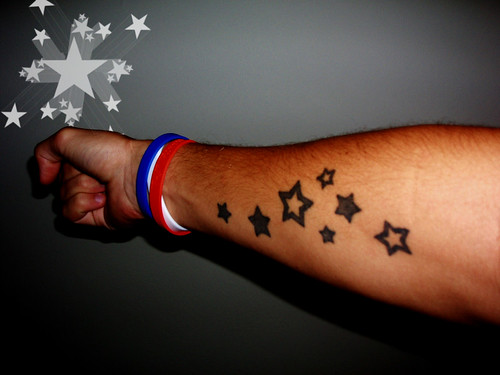
“Cheeky twat!” and he punches me on the arm. “No, I was talking about this…” And he gives me a conspirational look and rolls up his shirt sleeve to reveal a rather large tattoo on his right arm.
“Oh, you got it in the end.”
“Yeah, what do you think?” I study the design for a moment. It’s actually rather a good one. Admittedly, it doesn’t really go with the cuff linked shirt that he’s wearing, but with a different outfit I reckon it’d look really good.
“I like it,” I conclude. “It’s a bit bigger than I thought you were going to go for, but I think it looks really good.”
“Yeah, I thought there’s no point getting one unless it’s a big one and I really love it! I should have got it done years ago.”
“Well, you did keep banging on about it for ages, so at least I don’t have to listen to that anymore. But honestly, it looks good. I’ve got to get back to ITU though, I need to put a central line in before the patient goes to the CT scanner at
“Yeah, see you mate,” replies Andy and off he flounced back towards the surgical wards.

So, I arrive at work today feeling all refreshed and keen after the long weekend. It’s just after
She looks at me sorrowfully, shakes her head and replies, “I don’t think so.”

We had one of our regular teaching sessions at TheBigTeachingHospitalDownTheRoad today. I actually quite like these afternoons, it gives us a break from the day-to-day clinical work and also allows us to meet up with junior anaesthetists from other hospitals in the region and it gives us a chance to swap stories and just have a good old-fashioned gossip.

As a doctor who spends a lot of time looking after patients on life-support in the Critical Care Unit, I have a vested interest in paying close attention to the reports of the spread of the “Swine ‘Flu” epidemic.
This is a continuation of this post.
A bougie is basically a bendy stick, and when using one to incubate a person, you’re aiming to feel the stick running across the rings of cartilage in the patient’s windpipe – a bit like a child running a stick along a wooden fence. As I pushed the bougie down into this man’s body, I didn’t feel that sensation at all.
When I was putting the bougie in, my hands must have shifted slightly. Either that or the swelling and bleeding has got worse, because as I try to look down the man’s throat, I can no longer see what I thought I could see initially. It just looks like a bloody mess and I wonder if I ever really saw anything in the first place or if it was just my brain playing tricks on me and making me see what I wanted to see.
I figure that taking the bougie out and trying again is probably not be the best thing to do, but I did remember something that Dr Harrison told me when I was first learning how to use a bougie. ‘The trachea isn’t very long, even in the tallest of men. If you keep pushing the bougie down the trachea, you’ll get to a point when you can push it no further. If you push I down the oesophagus, you can pretty much push it all the way in.’
One of the things that I’ve noticed when dealing with acutely critically ill people like this is that as soon as the patient is intubated, everyone calms down a couple of notches. It’s almost as if the team breathes a collective sigh of relief. I think this mainly because when you induce anaesthesia and paralyse the patient, obviously they stop screaming and thrashing around which means that it suddenly becomes much easier for everyone else to do what the have to do. That could be that cutting off clothing, listening to the chest, feeling a pulse, palpating the abdomen, phoning radiology or simply taking in information and thinking about what the next steps should be. Whatever it is, it’s easier to do when you don’t have a screaming, thrashing patient in front of you.
Carl needs a CT scan of his head to see if he’s bleeding into his brain and thus needs urgent neurosurgery. Someone gets on the phone to the radiologist and the radiographers go off to warm up the CT scanner.
Major trauma really is time-critical. The sooner patient receives treatment, the better their outcome is. If you have an interest in trauma, phrases like “the golden hour” and “the platinum 10 minutes” will be familiar. In situations like this, the clock really is ticking and every minute unnecessarily wasted is potentially detrimental to the patient. The thing is, it’s so easy to waste time. It’s really tempting to “stay and play” in the resus room. You can put in arterial lines and central lines, set up infusers, warmers, splints etc… etc… All of these things take time, but these things may not be necessary or even helpful to the particular patient in front of you. You can spend lots of time trying to “do every thing by the book,” but lose sight of the fact that the whole point of “the book” is to identify the patient’s injuries and get them treated as quickly as is humanly possible.
Welcome to my Blog
.jpg)


 Posts
All Comments
Posts
All Comments